← 返回列表
🔗 原文
Hackaday Europe 2026: 半四轴半飞艇: 测试、飞行、生存。
Hackaday Europe 2026: Half Quad, Half Blimp: Test. Fly. Survive.

A great many drones out there, whether homebuilt or store-bought, follow the same basic format. Four motors, some kind of controller, and a lithium-polymer battery supplying the juice to keep everything in the air. It’s a format that produces a remarkably capable air vehicle, suitable for everything from high-speed camera work to urban search and rescue.

With that said, the format does have its limitations. [Suryansh Sharma] has been working on alternative designs for fancy and interesting drones that are half quadcopter and half blimp, and he came to Hackaday Europe 2026 to tell us all about it.
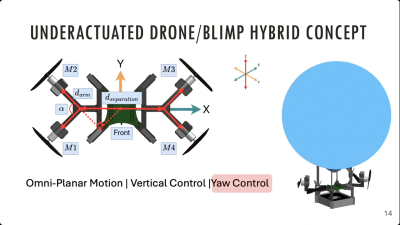
Combining a multirotor design with a balloon for additional lift proved useful for certain applications. Despite the motors all being mounted in the horizontal plane, vertical translation is possible by firing the right combination of motors, due to convenient aerodynamic effects.  Credit: slides

[Suryansh]’s talk took in a number of drone projects which he has been involved with. The first was the creatively-named BEAVIS, or Balloon Enabled Aerial Vehicle for IoT and Sensing. This was a project that aimed to tackle one of the greatest limitations of the common multirotor drone. Namely, as [Suryansh] so elegantly puts it, they “suck when it comes to staying in the air.” This is for a very simple reason—much like the helicopter, a multirotor drone must expend energy continuously to generate lift by spinning its propellers. Conventional multirotors don’t have wings that generate lift from forward motion, and any sort of gliding or similar behavior is basically impossible. Continual energy expenditure is the only thing keeping a multirotor aloft.

The point of BEAVIS was to fix this by combining drone tech with a simple lighter-than-air balloon. It’s an interesting combination, because a multirotor drone has excellent maneuverability and agility, but terrible endurance. A lighter-than-air balloon is quite the opposite, which has excellent endurance while suffering in all other respects. The BEAVIS concept outfits a small balloon with four motors in a split-cross configuration, which allows for planar translation as well as the ability to control yaw of the craft. With all four motors mounted horizontally in the same plane, it may seem like vertical control is not possible. However, by turning on two opposing props, it’s possible to create a low-pressure region beneath the craft which tends to push it downwards. Meanwhile, if you turn all four props on in the right directions, you create a high pressure region underneath the balloon which pushes the craft up. With the balloon, it has the benefit of being able to just hang in the air without continually burning through battery power. Endurance times of well over an hour were possible with this build, compared to maybe less than ten minutes for a comparable pure multirotor.
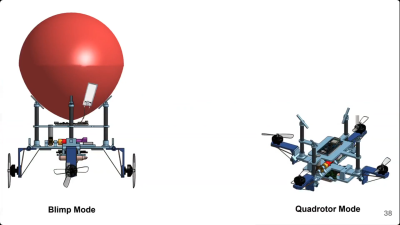
BEAVIS was developed into JANUS, a drone with an actuator system that pivots the motors so that it can fly in a pure quadcopter mode in the event of balloon failure. Credit: slides

BEAVIS was eventually developed into Janus— described as a “morphing quadrotor blimp with balloon failure resilience.” The goal was to build a craft that was viable for deployment in the real world, and that could undertake mobile ecological sensing work. The main difference to the previous design was that it would no longer solely fly as a balloon with horizontally-mounted props. Instead, Janus would feature a mechanism to allow the rotors to be positioned in the vertical axis to allow for conventional multirotor flight. This was key to allowing the craft to fly both as a lighter-than-air craft, and to survive and keep flying in the event the balloon burst or was otherwise damaged. The build was eventually deployed in Kenya to aid in ecological data collection for conservation efforts.
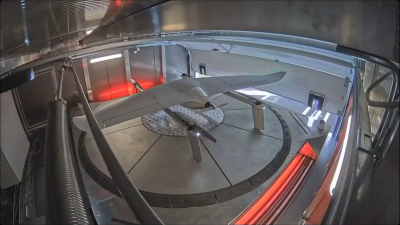
The Avy emergency response drone uses a metal launchpad and pogo pins to provide electrical power to keep the batteries topped off at all times. Credit: slides

[Suryansh] has been involved in other drone-related projects, too. Open Gimbal was a particularly interesting effort, involving the construction of a bench-testing rig for developing small multirotor drone craft. The 3-DoF platform offered unrestricted rotational freedom, allowing for a craft to be put through its paces in a controlled way without requiring a large open  space for free flight. [Suryansh] also discusses his work with a company called Avy, which specializes in VTOL drones with a focus on emergency response roles. The company has deployed drones that use multirotor technology to launch vertically, while relying on fixed wing aerodynamic elements to extend range and improve efficiency for longer flight times. The drones feature a neat charging setup, wherein pogo pins on the fins pick up power from the metal launchpad to ensure that batteries are fully charged and the drone is ready to go at all times.

Ultimately, multirotor drones have taken on their basic form for good reason. With that said, as [Suryansh]’s talk explains, modifications to the form can have great utility when made to suit a particularly specific mission or application. If you’re developing a drone for a certain purpose, and you’re running into hard limitations, you might try thinking outside the box to make something more fitting for your goals.

🤖 AI 总结
文章介绍了一种结合四旋翼和飞艇特点的混合无人机,强调其测试、飞行和生存能力。

A great many drones out there, whether homebuilt or store-bought, follow the same basic format. Four motors, some kind of controller, and a lithium-polymer battery supplying the juice to keep everything in the air. It’s a format that produces a remarkably capable air vehicle, suitable for everything from high-speed camera work to urban search and rescue.

With that said, the format does have its limitations. [Suryansh Sharma] has been working on alternative designs for fancy and interesting drones that are half quadcopter and half blimp, and he came to Hackaday Europe 2026 to tell us all about it.

Combining a multirotor design with a balloon for additional lift proved useful for certain applications. Despite the motors all being mounted in the horizontal plane, vertical translation is possible by firing the right combination of motors, due to convenient aerodynamic effects.  Credit: slides

[Suryansh]’s talk took in a number of drone projects which he has been involved with. The first was the creatively-named BEAVIS, or Balloon Enabled Aerial Vehicle for IoT and Sensing. This was a project that aimed to tackle one of the greatest limitations of the common multirotor drone. Namely, as [Suryansh] so elegantly puts it, they “suck when it comes to staying in the air.” This is for a very simple reason—much like the helicopter, a multirotor drone must expend energy continuously to generate lift by spinning its propellers. Conventional multirotors don’t have wings that generate lift from forward motion, and any sort of gliding or similar behavior is basically impossible. Continual energy expenditure is the only thing keeping a multirotor aloft.

The point of BEAVIS was to fix this by combining drone tech with a simple lighter-than-air balloon. It’s an interesting combination, because a multirotor drone has excellent maneuverability and agility, but terrible endurance. A lighter-than-air balloon is quite the opposite, which has excellent endurance while suffering in all other respects. The BEAVIS concept outfits a small balloon with four motors in a split-cross configuration, which allows for planar translation as well as the ability to control yaw of the craft. With all four motors mounted horizontally in the same plane, it may seem like vertical control is not possible. However, by turning on two opposing props, it’s possible to create a low-pressure region beneath the craft which tends to push it downwards. Meanwhile, if you turn all four props on in the right directions, you create a high pressure region underneath the balloon which pushes the craft up. With the balloon, it has the benefit of being able to just hang in the air without continually burning through battery power. Endurance times of well over an hour were possible with this build, compared to maybe less than ten minutes for a comparable pure multirotor.

BEAVIS was developed into JANUS, a drone with an actuator system that pivots the motors so that it can fly in a pure quadcopter mode in the event of balloon failure. Credit: slides

BEAVIS was eventually developed into Janus— described as a “morphing quadrotor blimp with balloon failure resilience.” The goal was to build a craft that was viable for deployment in the real world, and that could undertake mobile ecological sensing work. The main difference to the previous design was that it would no longer solely fly as a balloon with horizontally-mounted props. Instead, Janus would feature a mechanism to allow the rotors to be positioned in the vertical axis to allow for conventional multirotor flight. This was key to allowing the craft to fly both as a lighter-than-air craft, and to survive and keep flying in the event the balloon burst or was otherwise damaged. The build was eventually deployed in Kenya to aid in ecological data collection for conservation efforts.

The Avy emergency response drone uses a metal launchpad and pogo pins to provide electrical power to keep the batteries topped off at all times. Credit: slides

[Suryansh] has been involved in other drone-related projects, too. Open Gimbal was a particularly interesting effort, involving the construction of a bench-testing rig for developing small multirotor drone craft. The 3-DoF platform offered unrestricted rotational freedom, allowing for a craft to be put through its paces in a controlled way without requiring a large open  space for free flight. [Suryansh] also discusses his work with a company called Avy, which specializes in VTOL drones with a focus on emergency response roles. The company has deployed drones that use multirotor technology to launch vertically, while relying on fixed wing aerodynamic elements to extend range and improve efficiency for longer flight times. The drones feature a neat charging setup, wherein pogo pins on the fins pick up power from the metal launchpad to ensure that batteries are fully charged and the drone is ready to go at all times.

Ultimately, multirotor drones have taken on their basic form for good reason. With that said, as [Suryansh]’s talk explains, modifications to the form can have great utility when made to suit a particularly specific mission or application. If you’re developing a drone for a certain purpose, and you’re running into hard limitations, you might try thinking outside the box to make something more fitting for your goals.

原文
Hackaday Europe 2026: Half Quad, Half Blimp: Test. Fly. Survive.

A great many drones out there, whether homebuilt or store-bought, follow the same basic format. Four motors, some kind of controller, and a lithium-polymer battery supplying the juice to keep everything in the air. It’s a format that produces a remarkably capable air vehicle, suitable for everything from high-speed camera work to urban search and rescue.

With that said, the format does have its limitations. [Suryansh Sharma] has been working on alternative designs for fancy and interesting drones that are half quadcopter and half blimp, and he came to Hackaday Europe 2026 to tell us all about it.

Combining a multirotor design with a balloon for additional lift proved useful for certain applications. Despite the motors all being mounted in the horizontal plane, vertical translation is possible by firing the right combination of motors, due to convenient aerodynamic effects.  Credit: slides

[Suryansh]’s talk took in a number of drone projects which he has been involved with. The first was the creatively-named BEAVIS, or Balloon Enabled Aerial Vehicle for IoT and Sensing. This was a project that aimed to tackle one of the greatest limitations of the common multirotor drone. Namely, as [Suryansh] so elegantly puts it, they “suck when it comes to staying in the air.” This is for a very simple reason—much like the helicopter, a multirotor drone must expend energy continuously to generate lift by spinning its propellers. Conventional multirotors don’t have wings that generate lift from forward motion, and any sort of gliding or similar behavior is basically impossible. Continual energy expenditure is the only thing keeping a multirotor aloft.

The point of BEAVIS was to fix this by combining drone tech with a simple lighter-than-air balloon. It’s an interesting combination, because a multirotor drone has excellent maneuverability and agility, but terrible endurance. A lighter-than-air balloon is quite the opposite, which has excellent endurance while suffering in all other respects. The BEAVIS concept outfits a small balloon with four motors in a split-cross configuration, which allows for planar translation as well as the ability to control yaw of the craft. With all four motors mounted horizontally in the same plane, it may seem like vertical control is not possible. However, by turning on two opposing props, it’s possible to create a low-pressure region beneath the craft which tends to push it downwards. Meanwhile, if you turn all four props on in the right directions, you create a high pressure region underneath the balloon which pushes the craft up. With the balloon, it has the benefit of being able to just hang in the air without continually burning through battery power. Endurance times of well over an hour were possible with this build, compared to maybe less than ten minutes for a comparable pure multirotor.

BEAVIS was developed into JANUS, a drone with an actuator system that pivots the motors so that it can fly in a pure quadcopter mode in the event of balloon failure. Credit: slides

BEAVIS was eventually developed into Janus— described as a “morphing quadrotor blimp with balloon failure resilience.” The goal was to build a craft that was viable for deployment in the real world, and that could undertake mobile ecological sensing work. The main difference to the previous design was that it would no longer solely fly as a balloon with horizontally-mounted props. Instead, Janus would feature a mechanism to allow the rotors to be positioned in the vertical axis to allow for conventional multirotor flight. This was key to allowing the craft to fly both as a lighter-than-air craft, and to survive and keep flying in the event the balloon burst or was otherwise damaged. The build was eventually deployed in Kenya to aid in ecological data collection for conservation efforts.

The Avy emergency response drone uses a metal launchpad and pogo pins to provide electrical power to keep the batteries topped off at all times. Credit: slides

[Suryansh] has been involved in other drone-related projects, too. Open Gimbal was a particularly interesting effort, involving the construction of a bench-testing rig for developing small multirotor drone craft. The 3-DoF platform offered unrestricted rotational freedom, allowing for a craft to be put through its paces in a controlled way without requiring a large open  space for free flight. [Suryansh] also discusses his work with a company called Avy, which specializes in VTOL drones with a focus on emergency response roles. The company has deployed drones that use multirotor technology to launch vertically, while relying on fixed wing aerodynamic elements to extend range and improve efficiency for longer flight times. The drones feature a neat charging setup, wherein pogo pins on the fins pick up power from the metal launchpad to ensure that batteries are fully charged and the drone is ready to go at all times.

Ultimately, multirotor drones have taken on their basic form for good reason. With that said, as [Suryansh]’s talk explains, modifications to the form can have great utility when made to suit a particularly specific mission or application. If you’re developing a drone for a certain purpose, and you’re running into hard limitations, you might try thinking outside the box to make something more fitting for your goals.

中文翻译
Hackaday Europe 2026: 半四轴半飞艇: 测试、飞行、生存。

市面上大量无人机,无论是自制还是购买的成品,都遵循基本相同的基本格式。四个电机、某种控制器,以及一块锂聚合物电池提供动力,让一切停留在空中。这种格式能生产出功能极其强大的飞行器,适用于从高速摄影到城市搜救的各种用途。

话虽如此,这种格式确实有其局限性。[Suryansh Sharma] 一直在研究兼具四轴飞行器和飞艇特点的新型奇趣无人机替代设计,他来到 Hackaday Europe 2026,向我们详细介绍了这些设计。

将多旋翼设计与气球结合以提供额外升力,被证明对某些应用很有用。尽管所有电机都安装在水平面上,但通过启动正确的电机组合,利用便利的空气动力学效应,仍可实现垂直移动。 图片来源:幻灯片

[Suryansh] 的演讲涵盖了他参与过的多个无人机项目。第一个是创意名称 BEAVIS,即“用于物联网和传感的气球动力飞行器”。该项目旨在解决普通多旋翼无人机最大的局限性之一。正如 [Suryansh] 精辟地指出的,它们在“悬停方面表现糟糕”。原因很简单——与直升机非常相似,多旋翼无人机必须持续消耗能量,通过旋转螺旋桨来产生升力。传统的多旋翼没有机翼可以利用前飞产生升力,任何形式的滑翔等行为基本上是不可能的。持续的能量消耗是维持多旋翼飞行的唯一方式。

BEAVIS 的目的是通过将无人机技术与简单的轻于空气的气球相结合来解决这个问题。这是一个有趣的组合,因为多旋翼无人机机动性和灵活性极佳,但续航能力极差。轻于空气的气球则恰恰相反,续航能力极佳,但在其他所有方面都很差劲。BEAVIS 概念为一个带有四个电机的小型气球设计了分裂十字形配置,这使得平面移动以及控制飞行器的偏航成为可能。由于四个电机都水平安装在同一平面上,垂直控制似乎不可能实现。然而,通过启动两个对立的螺旋桨,可以在飞行器下方形成一个低压区域,从而使其向下移动。与此同时,如果以正确方向启动所有四个螺旋桨,则会在气球下方形成一个高压区域,推动飞行器向上移动。有了气球,它就能够在空中“悬停”,而无需持续消耗电池电量。这种构建方案能够实现超过一小时的续航时间,而相比之下,类似的纯多旋翼无人机可能不到十分钟。

BEAVIS 后来发展成了 JANUS,这是一种配备执行器系统的无人机,可以旋转电机,使其在气球失效的情况下能够以纯四轴飞行器模式飞行。图片来源:幻灯片

BEAVIS 最终发展成为 Janus——被描述为一种“具有气球失效恢复能力的变形四旋翼飞艇”。目标是制造一种能够在现实世界中部署、并能承担移动生态传感工作的飞行器。与前一个设计的主要区别在于,它将不再仅仅作为带有水平安装螺旋桨的气球飞行。相反,Janus 将配备一个机构,允许转子定位在垂直轴上,以实现传统的多旋翼飞行。这是让飞行器既能像轻于空气的飞行器一样飞行,又能在气球破裂或损坏的情况下存活并继续飞行的关键。该构建最终部署在肯尼亚,用于协助保护工作的生态数据收集。

Avy 应急响应无人机使用金属发射台和 pogo pin 来提供电力,以保持电池始终充满电。图片来源:幻灯片

[Suryansh] 还参与过其他与无人机相关的项目。Open Gimbal 是一个特别有趣的尝试,涉及构建一个用于开发小型多旋翼无人机飞行器的台架测试装置。这个三自由度平台提供了不受限制的旋转自由度,允许以受控方式对飞行器进行全面测试,而无需大型开放空间进行自由飞行。[Suryansh] 还讨论了他在一家名为 Avy 的公司的工作,该公司专注于垂直起降(VTOL)无人机,重点用于应急响应。该公司部署的无人机使用多旋翼技术垂直起飞,同时依靠固定翼气动元件来延长航程并提高效率,以实现更长的飞行时间。这些无人机配备了一个简洁的充电设置,机翼上的 pogo pin 从金属发射台获取电力,确保电池始终充满电,无人机随时可以起飞。

归根结底,多旋翼无人机采用其基本形式是有充分理由的。尽管如此,正如 [Suryansh] 的演讲所解释的那样,为了适应特定的任务或应用而对形式进行修改可能具有巨大的实用价值。如果你正在为某个特定目的开发无人机,并且遇到了难以逾越的限制,你可以尝试跳出固有思维,制造更适合你目标的东西。