← 返回列表
🔗 原文
1790年代的加密
Encryption in the 1790s

For as long as humans have had writing, there’s been a need to send secret messages. It is easy to think that Enigma machines and their immediate predecessors are old tech, but they are much more recent than ancient systems used by the Greeks and Romans. Even Thomas Jefferson, one of the founding fathers of the United States, was interested in encryption and is often said to have invented the Jefferson Disk machine for encryption. The truth is, the device is probably older than Jefferson, but he certainly thought about using it for secret communications.

Simple but Effective

Thomas Jefferson was, apparently, a fan of secret messages

The idea is simple. We make a series of disks. Each disk has a number on it and, around the edge, all the letters of the alphabet. The placement of each wheel with the same number is the same, but, overall, the arrangement is random. That is, all disks marked #5 might start with XCBYG, but all disks marked with #10 could start with FAYQL. You take one set of disks, and I keep the other set.

When we want to send secret messages, we agree to arrange our disks on an axle in the same order. Jefferson used a 36-disk system, so we might agree to go left to right with the odd numbers first and then the even numbers, or any other setup that we could agree on.

Encryption

Once the wheels are in place, encryption is simple. There’s a bar across the device, and you line up your message using a wheel for each letter: ENEMYCOMESBYSEA, for example. Then you look at any different row, which will now read something crazy like: FSRSSXQCGAEEFOR (plus the random letters on the rest of the disks). That’s the message you send.

Decryption

Upon receipt, you spell out the same message on the disks with the wheels in the agreed order. Once you have FSRSSXQCGAEEFOR lined up, you look at the other rows. It is a good chance that all of them will be gibberish except one. That’s the decoded message.

Of course, you could agree to shift a certain number of rows if you wanted to be sure. The order of the wheels amounts to a key, and while Jefferson wasn’t sure how secure this is, modern analysis says it is actually pretty good. If you don’t have the wheels and you don’t know the order of the wheels, it is actually excellent. If you have the wheels but don’t know the order, it is still very difficult to try all the permutations, especially without a computer.

History
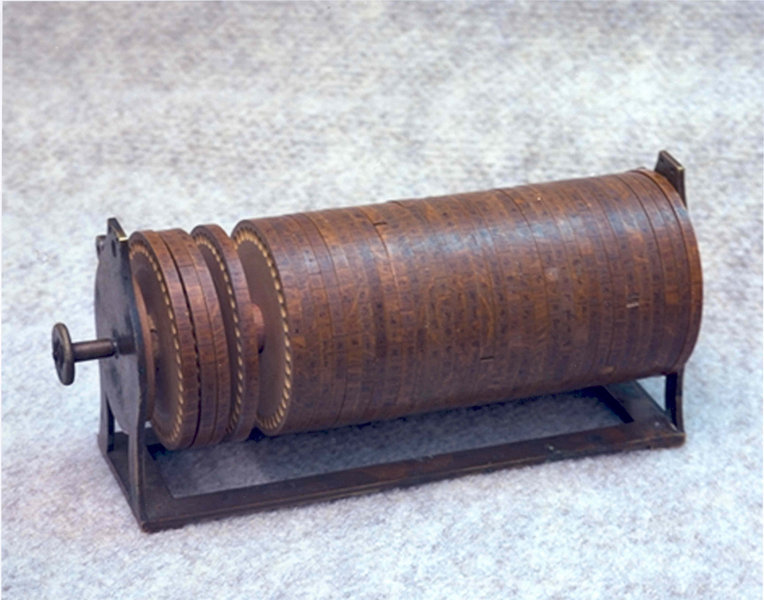
The National Cryptologic Museum has this partial device, which may or may not have been Jefferson’s

The Swede Fredrik Gripenstierna used a similar machine with 57 disks, but it had a slightly different purpose and operating principle. Jefferson described his device in the 1790s, and while he never claimed to invent it, the story has caught on that he did. Sometimes these are called Bazeries cylinders, as Etienne Bazeries had a 20-disk device in 1891, apparently independently invented.

It doesn’t appear that Jefferson or anyone else actually built the machine he described. There is an old device in the NSA museum that could be from Jefferson, but it isn’t clear that it was actually his or related to his writings.

Jefferson abandoned the scheme after learning about columnar transposition ciphers in 1803.

Use in the 20th Century

While Jefferson’s wheels never saw use, the US Military adapted Bazeries’ cylinder in 1922 and used the M-94 through 1942. The M-94 had 25 aluminum disks on a spindle.

The original prototype of the M-94 used a sliding strip arrangement instead of disks, and the Army returned to that style with the M-138A cipher machine in the 1930s. Each machine had 100 strips, and you had to select 30, further improving key security. It was used for some time, and you can see an example of it in the picture from the National Cryptologic Museum.

Everything Old is New

It is tempting to say the military used Jefferson’s wheel, but, in fact, the papers explaining the device were forgotten until 1922, and the prototype M-94s were developed between 1914 and 1917.

The system probably predates Jefferson anyway. Charles Babbage made references to disks with letters in 1854, although the exact arrangement he had in mind isn’t clear.

Of course, the Enigma and similar rotor-based machines took over during World War II. While making a disk-based code tool yourself would be easier (try styrofoam cups, like in the video below, if you don’t want to 3D print it), you can put in a bit more effort and make your own Enigma.

🤖 AI 总结
1790年代的加密技术表明,人类自书写出现起就需要秘密通信,恩尼格玛机只是漫长历史中的一环。

For as long as humans have had writing, there’s been a need to send secret messages. It is easy to think that Enigma machines and their immediate predecessors are old tech, but they are much more recent than ancient systems used by the Greeks and Romans. Even Thomas Jefferson, one of the founding fathers of the United States, was interested in encryption and is often said to have invented the Jefferson Disk machine for encryption. The truth is, the device is probably older than Jefferson, but he certainly thought about using it for secret communications.

Simple but Effective

Thomas Jefferson was, apparently, a fan of secret messages

The idea is simple. We make a series of disks. Each disk has a number on it and, around the edge, all the letters of the alphabet. The placement of each wheel with the same number is the same, but, overall, the arrangement is random. That is, all disks marked #5 might start with XCBYG, but all disks marked with #10 could start with FAYQL. You take one set of disks, and I keep the other set.

When we want to send secret messages, we agree to arrange our disks on an axle in the same order. Jefferson used a 36-disk system, so we might agree to go left to right with the odd numbers first and then the even numbers, or any other setup that we could agree on.

Encryption

Once the wheels are in place, encryption is simple. There’s a bar across the device, and you line up your message using a wheel for each letter: ENEMYCOMESBYSEA, for example. Then you look at any different row, which will now read something crazy like: FSRSSXQCGAEEFOR (plus the random letters on the rest of the disks). That’s the message you send.

Decryption

Upon receipt, you spell out the same message on the disks with the wheels in the agreed order. Once you have FSRSSXQCGAEEFOR lined up, you look at the other rows. It is a good chance that all of them will be gibberish except one. That’s the decoded message.

Of course, you could agree to shift a certain number of rows if you wanted to be sure. The order of the wheels amounts to a key, and while Jefferson wasn’t sure how secure this is, modern analysis says it is actually pretty good. If you don’t have the wheels and you don’t know the order of the wheels, it is actually excellent. If you have the wheels but don’t know the order, it is still very difficult to try all the permutations, especially without a computer.

History

The National Cryptologic Museum has this partial device, which may or may not have been Jefferson’s

The Swede Fredrik Gripenstierna used a similar machine with 57 disks, but it had a slightly different purpose and operating principle. Jefferson described his device in the 1790s, and while he never claimed to invent it, the story has caught on that he did. Sometimes these are called Bazeries cylinders, as Etienne Bazeries had a 20-disk device in 1891, apparently independently invented.

It doesn’t appear that Jefferson or anyone else actually built the machine he described. There is an old device in the NSA museum that could be from Jefferson, but it isn’t clear that it was actually his or related to his writings.

Jefferson abandoned the scheme after learning about columnar transposition ciphers in 1803.

Use in the 20th Century

While Jefferson’s wheels never saw use, the US Military adapted Bazeries’ cylinder in 1922 and used the M-94 through 1942. The M-94 had 25 aluminum disks on a spindle.

The original prototype of the M-94 used a sliding strip arrangement instead of disks, and the Army returned to that style with the M-138A cipher machine in the 1930s. Each machine had 100 strips, and you had to select 30, further improving key security. It was used for some time, and you can see an example of it in the picture from the National Cryptologic Museum.

Everything Old is New

It is tempting to say the military used Jefferson’s wheel, but, in fact, the papers explaining the device were forgotten until 1922, and the prototype M-94s were developed between 1914 and 1917.

The system probably predates Jefferson anyway. Charles Babbage made references to disks with letters in 1854, although the exact arrangement he had in mind isn’t clear.

Of course, the Enigma and similar rotor-based machines took over during World War II. While making a disk-based code tool yourself would be easier (try styrofoam cups, like in the video below, if you don’t want to 3D print it), you can put in a bit more effort and make your own Enigma.

原文
Encryption in the 1790s

For as long as humans have had writing, there’s been a need to send secret messages. It is easy to think that Enigma machines and their immediate predecessors are old tech, but they are much more recent than ancient systems used by the Greeks and Romans. Even Thomas Jefferson, one of the founding fathers of the United States, was interested in encryption and is often said to have invented the Jefferson Disk machine for encryption. The truth is, the device is probably older than Jefferson, but he certainly thought about using it for secret communications.

Simple but Effective

Thomas Jefferson was, apparently, a fan of secret messages

The idea is simple. We make a series of disks. Each disk has a number on it and, around the edge, all the letters of the alphabet. The placement of each wheel with the same number is the same, but, overall, the arrangement is random. That is, all disks marked #5 might start with XCBYG, but all disks marked with #10 could start with FAYQL. You take one set of disks, and I keep the other set.

When we want to send secret messages, we agree to arrange our disks on an axle in the same order. Jefferson used a 36-disk system, so we might agree to go left to right with the odd numbers first and then the even numbers, or any other setup that we could agree on.

Encryption

Once the wheels are in place, encryption is simple. There’s a bar across the device, and you line up your message using a wheel for each letter: ENEMYCOMESBYSEA, for example. Then you look at any different row, which will now read something crazy like: FSRSSXQCGAEEFOR (plus the random letters on the rest of the disks). That’s the message you send.

Decryption

Upon receipt, you spell out the same message on the disks with the wheels in the agreed order. Once you have FSRSSXQCGAEEFOR lined up, you look at the other rows. It is a good chance that all of them will be gibberish except one. That’s the decoded message.

Of course, you could agree to shift a certain number of rows if you wanted to be sure. The order of the wheels amounts to a key, and while Jefferson wasn’t sure how secure this is, modern analysis says it is actually pretty good. If you don’t have the wheels and you don’t know the order of the wheels, it is actually excellent. If you have the wheels but don’t know the order, it is still very difficult to try all the permutations, especially without a computer.

History

The National Cryptologic Museum has this partial device, which may or may not have been Jefferson’s

The Swede Fredrik Gripenstierna used a similar machine with 57 disks, but it had a slightly different purpose and operating principle. Jefferson described his device in the 1790s, and while he never claimed to invent it, the story has caught on that he did. Sometimes these are called Bazeries cylinders, as Etienne Bazeries had a 20-disk device in 1891, apparently independently invented.

It doesn’t appear that Jefferson or anyone else actually built the machine he described. There is an old device in the NSA museum that could be from Jefferson, but it isn’t clear that it was actually his or related to his writings.

Jefferson abandoned the scheme after learning about columnar transposition ciphers in 1803.

Use in the 20th Century

While Jefferson’s wheels never saw use, the US Military adapted Bazeries’ cylinder in 1922 and used the M-94 through 1942. The M-94 had 25 aluminum disks on a spindle.

The original prototype of the M-94 used a sliding strip arrangement instead of disks, and the Army returned to that style with the M-138A cipher machine in the 1930s. Each machine had 100 strips, and you had to select 30, further improving key security. It was used for some time, and you can see an example of it in the picture from the National Cryptologic Museum.

Everything Old is New

It is tempting to say the military used Jefferson’s wheel, but, in fact, the papers explaining the device were forgotten until 1922, and the prototype M-94s were developed between 1914 and 1917.

The system probably predates Jefferson anyway. Charles Babbage made references to disks with letters in 1854, although the exact arrangement he had in mind isn’t clear.

Of course, the Enigma and similar rotor-based machines took over during World War II. While making a disk-based code tool yourself would be easier (try styrofoam cups, like in the video below, if you don’t want to 3D print it), you can put in a bit more effort and make your own Enigma.

中文翻译
1790年代的加密

自从人类有了文字以来,就一直需要发送秘密信息。人们很容易认为恩尼格玛密码机及其直接前身是古老的技术,但它们比希腊人和罗马人使用的古代系统要新得多。就连美国的开国元勋之一托马斯·杰斐逊也对加密感兴趣,人们常说发明了杰斐逊盘加密机。事实是,这种设备可能比杰斐逊更古老,但他确实考虑过用它来进行秘密通信。

简单但有效

托马斯·杰斐逊显然是个秘密信息迷

这个想法很简单。我们制作一系列圆盘,每个圆盘上有一个编号,边缘上印有字母表的所有字母。具有相同编号的每个圆盘的字母排列是相同的,但总体而言排列是随机的。也就是说,所有标记为#5的圆盘可能以XCBYG开头,但所有标记为#10的圆盘可能以FAYQL开头。你拿一套圆盘,我保留另一套。

当我们要发送秘密信息时,我们约定将圆盘以相同顺序排列在一个轴上。杰斐逊使用了一个36圆盘系统,所以我们可能会约定从左到右先奇数编号后偶数编号,或者任何其他我们商定的设置。

加密

圆盘就位后,加密就很简单了。设备上有一根横杆,你用每个字母对应的一个圆盘排好你的信息:例如ENEMYCOMESBYSEA。然后你看向任何另一行,现在它会显示一些像FSRSSXQCGAEEFOR(加上其余圆盘上的随机字母)这样疯狂的内容。这就是你要发送的信息。

解密

收到后,你按照约定的顺序在圆盘上拼出同样的信息。一旦你将FSRSSXQCGAEEFOR对齐,就查看其他行。很有可能除了其中一行外,其他全是乱码,那就是解码后的信息。

当然,如果你想更保险,可以约定偏移一定行数。圆盘的顺序相当于密钥,虽然杰斐逊不确定这有多安全,但现代分析表明它实际上相当不错。如果你没有圆盘也不知道圆盘顺序,那实际上非常安全。如果你有圆盘但不知道顺序,尝试所有排列仍然非常困难,尤其是在没有计算机的情况下。

历史

国家密码学博物馆收藏了这件不完整的装置,可能是杰斐逊的,也可能不是

瑞典人Fredrik Gripenstierna使用过一种类似的机器,有57个圆盘,但目的和操作原理略有不同。杰斐逊在1790年代描述了他的装置,虽然他从未声称发明了它,但这个故事却传开了说他是发明者。有时这些装置被称为Bazeries圆柱,因为Etienne Bazeries在1891年有一个20圆盘的装置,显然是独立发明的。

似乎杰斐逊或其他任何人都没有实际制造过他描述的机器。NSA博物馆里有一件古老的装置,可能来自杰斐逊,但不确定是否真的是他的或与他的著作有关。

1803年,杰斐逊在了解到列换位密码后放弃了这一方案。

20世纪的使用

虽然杰斐逊的圆盘从未被使用过,但美国军方在1922年采用了Bazeries的圆柱,并一直使用M-94直到1942年。M-94有25个铝制圆盘装在一根轴上。

M-94的原型最初使用滑动条排列而不是圆盘,陆军在1930年代又回到了那种风格,推出了M-138A密码机。每台机器有100条条带,你必须选择30条,进一步提高了密钥安全性。它被使用了一段时间,你可以在国家密码学博物馆的图片中看到一个例子。

旧物新生

人们很容易说军方使用了杰斐逊的圆盘,但事实上,解释该装置的论文直到1922年才被遗忘,而M-94的原型是在1914年至1917年间开发的。

无论如何,这个系统可能早于杰斐逊。Charles Babbage在1854年提到了带字母的圆盘,尽管他构想的精确排列尚不清楚。

当然,恩尼格玛和类似的基于转子的机器在二战期间占据了主导地位。虽然自己制作一个基于圆盘的编码工具更容易(如果不想3D打印它,可以试试下面的视频中用聚苯乙烯泡沫塑料杯的方法),但你可以多花点精力制作自己的恩尼格玛机