← 返回列表
🔗 原文
基于绿茶构建有机液流电池
Building an Organic Flow Battery Based on Green Tea

As simple of a concept flow batteries are, the used chemicals can still be somewhat problematic in the context of a school experiment. To this end [Markus Bindhammer] decided to implement a flow battery version that uses compounds from green tea for its electrolyte, based on a German research paper from 2016.
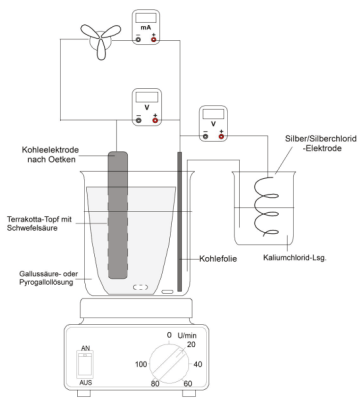
The flow battery construction from the paper by Rosenberg et al., 2016.

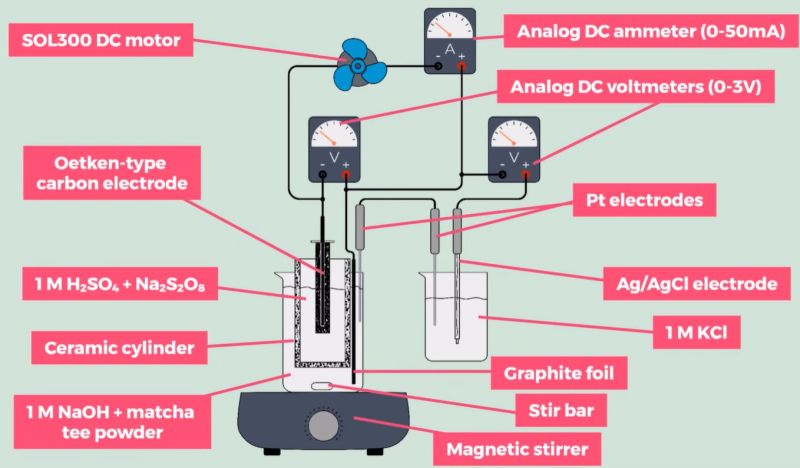
These organic flow batteries can use gallic acid, pyrogallol as well as the polyphenols in green tea, making them rather safe even in the hands of more careless students. The demonstrated flow battery uses a carbon electrode with activated carbon around it to increase surface area, a platinum wire electrode, and a graphite foil as as third electrode.

In the paper a silver electrode is also used, along with the additional electrodes, and a terracotta flower pot as the barrier between the carbon and graphite electrodes, with [Markus] further explaining that there are fortunately cheaper options than what he is using, especially with the flower pot instead of a special ceramic vessel.

The electrolyte solution has epigallocatechin gallate (EGCG) dissolved in it, which here comes in the form of finely ground green tea powder (commonly known as matcha), which so happens to be pretty rich in this substance. In the below graphic by [Markus] you can see the complete set of solutions and other relevant details.

Of course, the performance of this type of flow cell isn’t amazing, with a cell voltage of less than a volt and a few mA of current, but it’s enough to spin a small fan, and to light up a few LEDs. This would be more than enough to demonstrate the reaction and flow cells in general, as long as you don’t mind donating some tasty matcha to science.
🤖 AI 总结
基于绿茶制作有机流动电池,旨在解决学校实验中化学品的不安全或复杂问题。

As simple of a concept flow batteries are, the used chemicals can still be somewhat problematic in the context of a school experiment. To this end [Markus Bindhammer] decided to implement a flow battery version that uses compounds from green tea for its electrolyte, based on a German research paper from 2016.

The flow battery construction from the paper by Rosenberg et al., 2016.

These organic flow batteries can use gallic acid, pyrogallol as well as the polyphenols in green tea, making them rather safe even in the hands of more careless students. The demonstrated flow battery uses a carbon electrode with activated carbon around it to increase surface area, a platinum wire electrode, and a graphite foil as as third electrode.

In the paper a silver electrode is also used, along with the additional electrodes, and a terracotta flower pot as the barrier between the carbon and graphite electrodes, with [Markus] further explaining that there are fortunately cheaper options than what he is using, especially with the flower pot instead of a special ceramic vessel.

The electrolyte solution has epigallocatechin gallate (EGCG) dissolved in it, which here comes in the form of finely ground green tea powder (commonly known as matcha), which so happens to be pretty rich in this substance. In the below graphic by [Markus] you can see the complete set of solutions and other relevant details.

Of course, the performance of this type of flow cell isn’t amazing, with a cell voltage of less than a volt and a few mA of current, but it’s enough to spin a small fan, and to light up a few LEDs. This would be more than enough to demonstrate the reaction and flow cells in general, as long as you don’t mind donating some tasty matcha to science.

原文
Building an Organic Flow Battery Based on Green Tea

As simple of a concept flow batteries are, the used chemicals can still be somewhat problematic in the context of a school experiment. To this end [Markus Bindhammer] decided to implement a flow battery version that uses compounds from green tea for its electrolyte, based on a German research paper from 2016.

The flow battery construction from the paper by Rosenberg et al., 2016.

These organic flow batteries can use gallic acid, pyrogallol as well as the polyphenols in green tea, making them rather safe even in the hands of more careless students. The demonstrated flow battery uses a carbon electrode with activated carbon around it to increase surface area, a platinum wire electrode, and a graphite foil as as third electrode.

In the paper a silver electrode is also used, along with the additional electrodes, and a terracotta flower pot as the barrier between the carbon and graphite electrodes, with [Markus] further explaining that there are fortunately cheaper options than what he is using, especially with the flower pot instead of a special ceramic vessel.

The electrolyte solution has epigallocatechin gallate (EGCG) dissolved in it, which here comes in the form of finely ground green tea powder (commonly known as matcha), which so happens to be pretty rich in this substance. In the below graphic by [Markus] you can see the complete set of solutions and other relevant details.

Of course, the performance of this type of flow cell isn’t amazing, with a cell voltage of less than a volt and a few mA of current, but it’s enough to spin a small fan, and to light up a few LEDs. This would be more than enough to demonstrate the reaction and flow cells in general, as long as you don’t mind donating some tasty matcha to science.

中文翻译
基于绿茶构建有机液流电池

虽然液流电池的概念很简单,但在学校实验的背景下,所使用的化学品仍然可能存在一些问题。为此,[Markus Bindhammer] 决定基于2016年的一篇德国研究论文,实现一种使用绿茶中的化合物作为电解液的液流电池版本。

The flow battery construction from the paper by Rosenberg et al., 2016.

这些有机液流电池可以使用没食子酸、焦酚以及绿茶中的多酚类物质,即使由更粗心的学生操作也相当安全。演示的液流电池使用碳电极,周围包裹活性炭以增加表面积,一个铂丝电极,以及一个石墨箔作为第三电极。

在论文中还使用了银电极以及其他电极,并用一个赤陶花盆作为碳电极和石墨电极之间的隔离层,[Markus] 进一步解释说,幸运的是,有比他使用的方法更便宜的选择,尤其是用花盆代替特殊的陶瓷容器。

电解液中溶解了表没食子儿茶素没食子酸酯(EGCG),这里以精细研磨的绿茶粉(俗称抹茶)的形式存在,恰好这种粉末富含该物质。在下面[Markus]的图表中,你可以看到完整的溶液组及其他相关细节。

当然,这种液流池的性能并不惊人,电池电压不到1伏,电流只有几毫安,但足以驱动一个小风扇和点亮几个LED。这足以演示反应和一般的液流电池,只要你不介意把一些美味的抹茶贡献给科学。