← 返回列表
🔗 原文
将8192个MCU粘合在一起,打造一个GPU
Gluing 8192 MCUs Together to Make a GPU

What do you get when you take 8,192 CH570 MCUs, put them on custom PCBs, and write firmware for this interconnected gaggle of cores? In the case of [bitluni]’s project, you get something that’s decidedly cluster-shaped.

These cheap MCUs feature a QingKe 32-bit RISC-V core that’s clocked at a maximum of 100 MHz, with an RV32IMBC instruction set. This means that they support integers, integer multiplication and division, bit manipulation, and compressed instructions, but no atomic, vector, or floating-point instructions.

The basic concept was to use a single MCU per pixel, but once you start scaling up a measly 10 mA and ~$0.10 per MCU to literally tens of thousands of them, you’re suddenly talking about thousands of dollars in hardware as well as a cool 655.36A at 3.3V – or 2 kW –  for something close to QVGA resolution at 320×200. Clearly this would be a rather crazy project to implement, which is why each MCU also got its own RGB LED to immediately create the pixel.
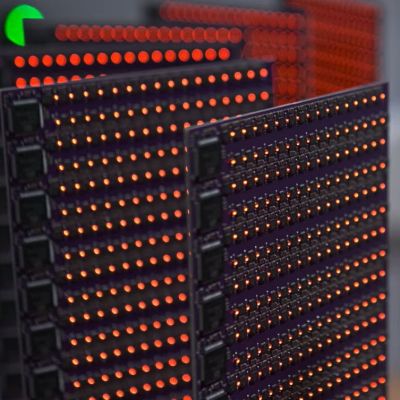
In order to fit so many MCUs, the design was split across multiple PCBs, or blades, connected to a backplane. On each blade, a group of MCUs is connected to a controller MCU, in the form of a larger MCU. With some prototype blades assembled and bodges implemented, each single MCU could then be programmed.

For the power supply, a 3 kW Corsair ATX PSU was used to supply power to the subsequent power stages. As a result, the first prototype looks like a pretty fancy addressable RGB LED matrix.

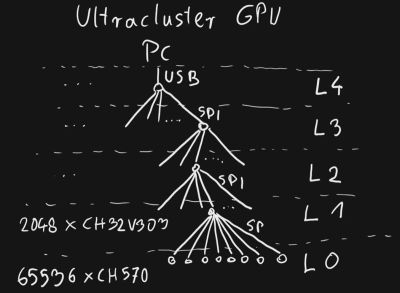
This is said to be only the first step, with this ‘Ultracluster GPU’ still getting a few more levels tacked onto it to make it into something that’s more GPU-shaped. Probably the biggest question here is whether the final version will be able to generate said QVGA output image without needing more power than what a typical 230 V, 16A European outlet can provide.

We think that [Jensen Huang] probably will be more scared of the ESP32-S3-based video card that [bitluni] made before, though at least [bitluni] seems to be having fun making more MCU-based clusters, such as this one from 2024 and this one from 2025.

🤖 AI 总结
用8192个CH570微控制器定制PCB互联,编写固件,成功组装出一个功能型GPU。

What do you get when you take 8,192 CH570 MCUs, put them on custom PCBs, and write firmware for this interconnected gaggle of cores? In the case of [bitluni]’s project, you get something that’s decidedly cluster-shaped.

These cheap MCUs feature a QingKe 32-bit RISC-V core that’s clocked at a maximum of 100 MHz, with an RV32IMBC instruction set. This means that they support integers, integer multiplication and division, bit manipulation, and compressed instructions, but no atomic, vector, or floating-point instructions.

The basic concept was to use a single MCU per pixel, but once you start scaling up a measly 10 mA and ~$0.10 per MCU to literally tens of thousands of them, you’re suddenly talking about thousands of dollars in hardware as well as a cool 655.36A at 3.3V – or 2 kW –  for something close to QVGA resolution at 320×200. Clearly this would be a rather crazy project to implement, which is why each MCU also got its own RGB LED to immediately create the pixel.

In order to fit so many MCUs, the design was split across multiple PCBs, or blades, connected to a backplane. On each blade, a group of MCUs is connected to a controller MCU, in the form of a larger MCU. With some prototype blades assembled and bodges implemented, each single MCU could then be programmed.

For the power supply, a 3 kW Corsair ATX PSU was used to supply power to the subsequent power stages. As a result, the first prototype looks like a pretty fancy addressable RGB LED matrix.

This is said to be only the first step, with this ‘Ultracluster GPU’ still getting a few more levels tacked onto it to make it into something that’s more GPU-shaped. Probably the biggest question here is whether the final version will be able to generate said QVGA output image without needing more power than what a typical 230 V, 16A European outlet can provide.

We think that [Jensen Huang] probably will be more scared of the ESP32-S3-based video card that [bitluni] made before, though at least [bitluni] seems to be having fun making more MCU-based clusters, such as this one from 2024 and this one from 2025.

原文
Gluing 8192 MCUs Together to Make a GPU

What do you get when you take 8,192 CH570 MCUs, put them on custom PCBs, and write firmware for this interconnected gaggle of cores? In the case of [bitluni]’s project, you get something that’s decidedly cluster-shaped.

These cheap MCUs feature a QingKe 32-bit RISC-V core that’s clocked at a maximum of 100 MHz, with an RV32IMBC instruction set. This means that they support integers, integer multiplication and division, bit manipulation, and compressed instructions, but no atomic, vector, or floating-point instructions.

The basic concept was to use a single MCU per pixel, but once you start scaling up a measly 10 mA and ~$0.10 per MCU to literally tens of thousands of them, you’re suddenly talking about thousands of dollars in hardware as well as a cool 655.36A at 3.3V – or 2 kW –  for something close to QVGA resolution at 320×200. Clearly this would be a rather crazy project to implement, which is why each MCU also got its own RGB LED to immediately create the pixel.

In order to fit so many MCUs, the design was split across multiple PCBs, or blades, connected to a backplane. On each blade, a group of MCUs is connected to a controller MCU, in the form of a larger MCU. With some prototype blades assembled and bodges implemented, each single MCU could then be programmed.

For the power supply, a 3 kW Corsair ATX PSU was used to supply power to the subsequent power stages. As a result, the first prototype looks like a pretty fancy addressable RGB LED matrix.

This is said to be only the first step, with this ‘Ultracluster GPU’ still getting a few more levels tacked onto it to make it into something that’s more GPU-shaped. Probably the biggest question here is whether the final version will be able to generate said QVGA output image without needing more power than what a typical 230 V, 16A European outlet can provide.

We think that [Jensen Huang] probably will be more scared of the ESP32-S3-based video card that [bitluni] made before, though at least [bitluni] seems to be having fun making more MCU-based clusters, such as this one from 2024 and this one from 2025.

中文翻译
将8192个MCU粘合在一起,打造一个GPU

当你将8192个CH570 MCU放在定制的PCB上,并为这些互联的核心群编写固件,你会得到什么?就[bitluni]的项目而言,你得到的绝对是一个集群形状的东西

这些廉价MCU采用青科(QingKe)32位RISC-V核心,最大时钟频率为100 MHz,指令集为RV32IMBC。这意味着它们支持整数运算、整数乘除法、位操作和压缩指令,但不支持原子操作、向量指令或浮点指令。

基本概念是每个像素使用一个MCU,但一旦将微不足道的10 mA和每个约0.10美元的MCU扩展到数万个,你突然间就在谈论数千美元的硬件,以及一个在3.3V下达到655.36A(即2 kW)的系统,分辨率接近QVGA的320×200。显然这是一个相当疯狂的项目,因此每个MCU还配有自己的RGB LED,直接用来创建像素。

为了容纳如此多的MCU,设计被分配到了多块PCB(或称为刀片)上,这些刀片连接到一个背板。每块刀片上,一组MCU连接到一个作为控制器的更大MCU。在原型刀片组装并完成临时接线后,每个单独的MCU就可以被编程了。

电源方面,使用了一个3千瓦的Corsair ATX电源,为后续的功率级供电。结果,第一个原型看起来就像一个相当花哨的可寻址RGB LED矩阵。

据说这只是第一步,这个“Ultracluster GPU”还将增加几个层级,使其更像一个GPU的形状。这里最大的问题可能是,最终版本是否能在不消耗超过典型欧洲230V/16A插座供电能力的情况下,生成所说的QVGA输出图像。

我们认为,[Jensen Huang]更可能会害怕[bitluni]之前制作的基于ESP32-S3的显卡,不过至少[bitluni]似乎在制作更多基于MCU的集群时玩得很开心,比如2024年的这个2025年的这个