← 返回列表
🔗 原文
多亏一款骗人产品,我才了解了接地回路隔离器。
Learning About Ground Loop Isolators thanks to a Scam Product

When [Denki Otaku] bought a ¥1,200 (roughly €6.5) XLR ground loop isolator off Japanese Amazon, he initially didn’t suspect that anything was off. Since they’re fairly simple devices, with basically a 1:1 transformer per channel in some kind of enclosure, the price wasn’t unreasonable.
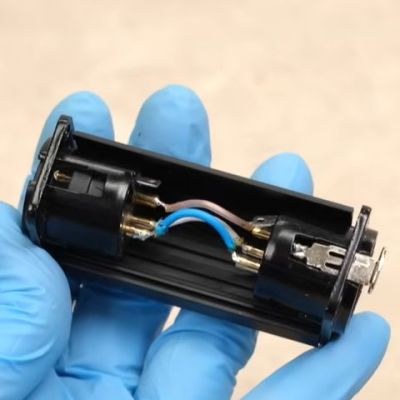
That’s before a teardown showed that this ‘ground loop isolator’ actually contains direct wiring between the XLR sockets, but that doesn’t mean that you cannot still make an educational video about the real devices.

First the basic theory is explained, before the fake ground loop isolator is subjected to an analysis, showing why you’d want to use the real deal. Of course, detecting a fake one is pretty easy, as a simple continuity test with a multimeter  or similar will show that DC passes right through the fake isolator.

Next a real ground loop isolator was designed with a custom PCB and a high-pass filter added to the feature list. Here rather than a very basic filter with cheapo parts there was definitely some gold-plating going on, but it does show what you can do in addition to just adding a few simple transformers for ground isolation purposes.
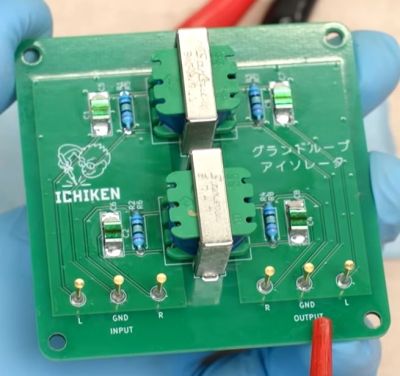
The finished ground loop isolator device is pretty large, and would definitely require a larger enclosure than the homeopathic device, but it makes for an easy test bed with convenient access during the subsequent analysis.

Here each of the two channels has its own transformer and filter, with an initial test just by ear making the injected 2 kHz noise signal appear to go completely away.

Next, an oscilloscope is used to visualize the functionality, with the non-isolated 440 Hz test signal first shown with and without the injected noise, showing the clear impact of the noise and subsequently the isolator.

Of course, high-frequency noises will still pass through the transformer via parasitic capacitance leakage between the windings, so it’s not a silver bullet. Here the analysis at the end of the video shows the noise-rejection characteristics of these isolators, and why adding a high-pass filter makes a lot of sense. Finally, the scam device’s XLR connectors were reused in an enclosure for this custom board, giving it some purpose after all.

🤖 AI 总结
作者通过购买一个廉价的XLR接地回路隔离器(疑似骗局产品),学到了关于接地回路隔离器的知识。

When [Denki Otaku] bought a ¥1,200 (roughly €6.5) XLR ground loop isolator off Japanese Amazon, he initially didn’t suspect that anything was off. Since they’re fairly simple devices, with basically a 1:1 transformer per channel in some kind of enclosure, the price wasn’t unreasonable.

That’s before a teardown showed that this ‘ground loop isolator’ actually contains direct wiring between the XLR sockets, but that doesn’t mean that you cannot still make an educational video about the real devices.

First the basic theory is explained, before the fake ground loop isolator is subjected to an analysis, showing why you’d want to use the real deal. Of course, detecting a fake one is pretty easy, as a simple continuity test with a multimeter  or similar will show that DC passes right through the fake isolator.

Next a real ground loop isolator was designed with a custom PCB and a high-pass filter added to the feature list. Here rather than a very basic filter with cheapo parts there was definitely some gold-plating going on, but it does show what you can do in addition to just adding a few simple transformers for ground isolation purposes.

The finished ground loop isolator device is pretty large, and would definitely require a larger enclosure than the homeopathic device, but it makes for an easy test bed with convenient access during the subsequent analysis.

Here each of the two channels has its own transformer and filter, with an initial test just by ear making the injected 2 kHz noise signal appear to go completely away.

Next, an oscilloscope is used to visualize the functionality, with the non-isolated 440 Hz test signal first shown with and without the injected noise, showing the clear impact of the noise and subsequently the isolator.

Of course, high-frequency noises will still pass through the transformer via parasitic capacitance leakage between the windings, so it’s not a silver bullet. Here the analysis at the end of the video shows the noise-rejection characteristics of these isolators, and why adding a high-pass filter makes a lot of sense. Finally, the scam device’s XLR connectors were reused in an enclosure for this custom board, giving it some purpose after all.

原文
Learning About Ground Loop Isolators thanks to a Scam Product

When [Denki Otaku] bought a ¥1,200 (roughly €6.5) XLR ground loop isolator off Japanese Amazon, he initially didn’t suspect that anything was off. Since they’re fairly simple devices, with basically a 1:1 transformer per channel in some kind of enclosure, the price wasn’t unreasonable.

That’s before a teardown showed that this ‘ground loop isolator’ actually contains direct wiring between the XLR sockets, but that doesn’t mean that you cannot still make an educational video about the real devices.

First the basic theory is explained, before the fake ground loop isolator is subjected to an analysis, showing why you’d want to use the real deal. Of course, detecting a fake one is pretty easy, as a simple continuity test with a multimeter  or similar will show that DC passes right through the fake isolator.

Next a real ground loop isolator was designed with a custom PCB and a high-pass filter added to the feature list. Here rather than a very basic filter with cheapo parts there was definitely some gold-plating going on, but it does show what you can do in addition to just adding a few simple transformers for ground isolation purposes.

The finished ground loop isolator device is pretty large, and would definitely require a larger enclosure than the homeopathic device, but it makes for an easy test bed with convenient access during the subsequent analysis.

Here each of the two channels has its own transformer and filter, with an initial test just by ear making the injected 2 kHz noise signal appear to go completely away.

Next, an oscilloscope is used to visualize the functionality, with the non-isolated 440 Hz test signal first shown with and without the injected noise, showing the clear impact of the noise and subsequently the isolator.

Of course, high-frequency noises will still pass through the transformer via parasitic capacitance leakage between the windings, so it’s not a silver bullet. Here the analysis at the end of the video shows the noise-rejection characteristics of these isolators, and why adding a high-pass filter makes a lot of sense. Finally, the scam device’s XLR connectors were reused in an enclosure for this custom board, giving it some purpose after all.

中文翻译
多亏一款骗人产品,我才了解了接地回路隔离器。

当[Denki Otaku]从日本亚马逊上以1200日元(约6.5欧元)的价格购买了一个XLR接地环路隔离器时,他起初并未怀疑有什么不对劲。因为这类设备相当简单,基本上是每个通道内置一个1:1变压器,装在外壳里,这个价格并不离谱。

然而,拆解显示这个“接地环路隔离器”实际上只是将XLR插座之间直连,但这并不意味着你不能借此制作一个关于真实设备的教育视频

首先解释了基本原理,然后对这个假的接地环路隔离器进行了分析,展示了为什么需要使用真货。当然,检测假货相当容易:只需用万用表或类似工具进行简单的通断测试,就会发现直流电可以轻松通过这个假隔离器。

接下来,设计了一款真正的接地环路隔离器,采用了定制PCB,并在功能列表中加入了高通滤波器。虽然这里使用的不是最基本的廉价元件,而是有些“镀金”的倾向,但它确实展示了除了添加几个简单的变压器用于接地隔离之外,还能做些什么。

最终完成的接地环路隔离器设备体积相当大,肯定需要一个比那个“顺势疗法”设备更大的外壳,但其便于测试的布局使得后续分析时的接入非常方便。

两个通道各自拥有独立的变压器和滤波器,初步仅凭耳朵测试,注入的2 kHz噪声信号似乎完全消失了。

接着,使用示波器可视化其功能,首先展示了未隔离的440 Hz测试信号在有/无注入噪声下的情况,清晰显示了噪声的影响以及随后的隔离效果。

当然,高频噪声仍然会通过绕组之间的寄生电容泄漏穿过变压器,所以它并非万能药。视频结尾的分析展示了这些隔离器的噪声抑制特性,以及为什么添加高通滤波器非常有意义。最后,这款诈骗设备上的XLR连接器被重复利用,安装在了这个定制板子的外壳上,总算有了点用处。